
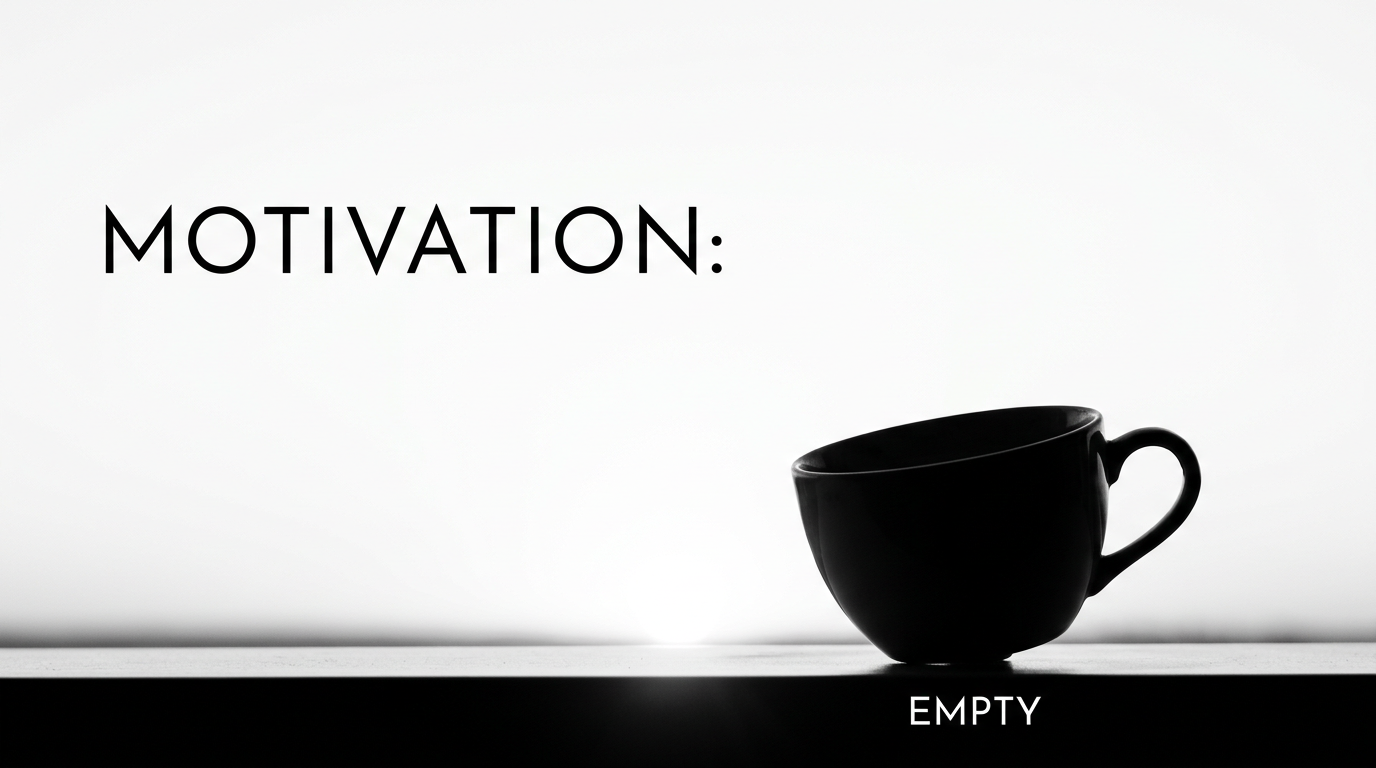
Motivation is weather. You do not build a house expecting permanent sunshine.
If your entire habit depends on feeling inspired, you do not have a habit — you have a mood.
The problem: motivation is real — and unreliable
Motivation often appears:
- After a podcast.
- After shame.
- After a fresh calendar page.
It disappears:
- After a bad night’s sleep.
- After one stressful email.
- After Wednesday.
That is not a character flaw. It is biology meeting modern life.
Replace motivation with three boring pillars
- Identity (small): “I am someone who shows up for five minutes” beats “I will transform my life.”
- Environment: make the right action obvious and the wrong action slightly annoying.
- Proof: a tap, a line, a check — something your brain can see the same day.
This is the hidden engine behind “discipline”: not pain, but repeatability.
Connection to habits that actually stick
We wrote how to build habits that stick as a companion to this — same idea, different angle: shrink the promise until it survives your worst week.
If you want lightweight behavioral proof (without turning life into a scoreboard), tools that log small checks and show patterns over time can help — see Quick Actions and heatmaps.
Bottom line
Motivation fails because it was never meant to be an engine — it is a spark. Your real engine is identity + environment + proof. Build those, and you stop negotiating with your feelings every morning.